📖 中文版在下方 — scroll down for the Chinese version.
Written August 20, 2026. This is not investment advice — it's an engineer's observation of the economy he happens to be running inside.
Spend long enough in this industry and a habit forms: you only look at technology.
Today it's AI, tomorrow a new framework, then servers, databases, chips, model benchmarks. Macro economics, interest rates, exchange rates, inflation — those feel like someone else's problem, something for people in finance.
I've come to think that view is incomplete.
An engineer doesn't have to trade stocks, but shouldn't be completely illiterate about the economy.
Because the economic environment eventually reaches every engineer — through corporate orders, client budgets, salaries, hiring, funding costs, hardware prices, even which technical direction gets funded.
A lot of what we experience as "technology changing" is actually the economy changing.
1. Why this question got my attention
One phenomenon has been on my mind lately.
Chinese households hold a substantial amount of savings, and yet the willingness to spend is weak.
There are things here worth comparing to what Japan went through after its bubble economy ended.
It isn't that people have no money. It's that many people have started to feel:
- future income and employment are less certain;
- real estate no longer supplies a reliable expectation of appreciation;
- taking on more debt is unattractive;
- if a purchase can be postponed, postpone it;
- money is better left in the bank.
Individually, every one of those choices is rational.
But when hundreds of millions of people make them at the same time, you get a macro feedback loop:
Households cut spending → corporate revenue falls → firms cut investment and hiring → wage and job expectations fall → households become even more reluctant to spend → savings keep rising.
It looks a lot like a deadlock in a program.
Every thread is behaving correctly on its own. The system as a whole ends up in a state that's very hard to exit.
2. The money doesn't shrink — so why is it worth less?
Say someone earned 3,000 yuan a month twenty years ago and still earns 3,000 yuan today.
The number hasn't moved at all.
But over those twenty years rent went up, food went up, labor costs went up, services went up.
So today's 3,000 yuan and the 3,000 yuan of twenty years ago are not the same object.
The question worth asking isn't:
How much money is in my bank account?
It's:
How much can my money still buy?
A simple way to hold it:
Real purchasing power ≈ nominal income ÷ price level
That's why a pay cut can happen without your salary ever going down.
The same thing happens to savings.
Assume a one-year deposit rate of 1%, and prices rising 2% a year over the long run.
A million yuan becomes 1.01 million after a year. The balance went up.
Purchasing power went down.
In other words:
Nominal wealth increased, real wealth decreased.
3. Which is why mild inflation matters
For most people the word "inflation" triggers one reaction: things get more expensive — how is that not bad?
But in macro economics the dangerous case isn't only high inflation.
Sustained deflation is just as dangerous.
Imagine a car sells for 200,000 today. Everyone believes it'll sell for 180,000 next year.
What's the rational individual decision?
Buy next year.
If housing, cars, appliances, and industrial equipment all carry that expectation, everyone delays.
The result:
Spending falls → firms cut prices → profits fall → investment falls → wages fall → spending falls further.
That's why modern economies generally prefer a specific state:
Low, stable, positive inflation. Around 2%.
What it's really telling everyone is:
Money sitting perfectly still forever is not necessarily the optimal choice.
4. Is China doing this right now?
This can't be answered with a clean yes or no.
More precisely:
China clearly wants to move out of low inflation — and deflationary pressure — back toward mild price increases.
That is a completely different proposition from "the government is deliberately vaporizing people's savings."
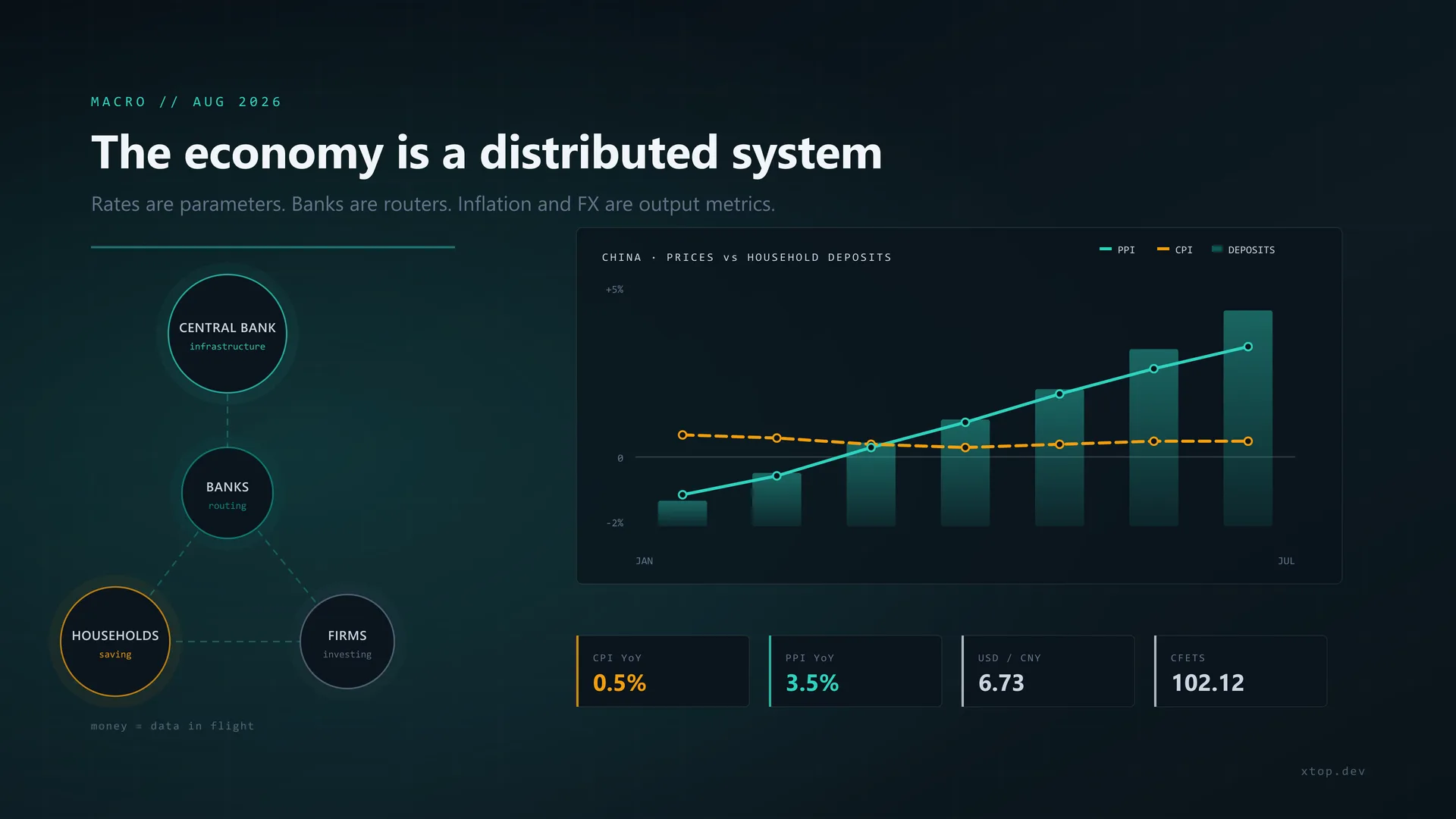
As of July 2026, China's CPI rose 0.5% year over year, averaging 0.9% over January–July; core CPI excluding food and energy rose 0.9%.
Consumer prices, in other words, remain quite mild.
But another series has started to move.
July 2026 PPI — factory-gate prices for industrial producers — rose 3.5% year over year, with producer goods up 4.8%.
And there was a signal worth noting in Q2: nominal GDP growth moved back above real growth, and the GDP deflator turned positive again after a long stretch of negative readings.
Put differently:
The production side and the broader price system are showing early signs of reflation.
The household consumption side hasn't caught up.
5. The strange part: the RMB is appreciating
Simple economic intuition says:
Weak economy → rate cuts → looser money → the currency should depreciate.
Instead the RMB has been notably strong. In mid-August, the onshore rate touched roughly 6.73 per US dollar, one of its stronger levels in recent years.
That looks like it contradicts everything above. It doesn't.
Because "is the RMB worth a lot?" has at least two different rulers.
Ruler one: RMB against domestic goods
How much does 100 yuan buy? Determined by domestic prices.
Ruler two: RMB against foreign currency
How many yuan per dollar? That's the exchange rate.
So this can absolutely happen at the same time:
Domestic purchasing power falls 2% a year, while the RMB gains 5% against the dollar.
Both statements can be true simultaneously.
6. Why is the RMB strong against the dollar?
Part of the answer is the dollar itself.
Which is why USD/CNY alone is the wrong thing to watch.
A better indicator is the CFETS RMB exchange rate index — the RMB against a basket of currencies rather than against the dollar alone.
As of August 14, 2026, the CFETS index stood at 102.12.
So judging whether the RMB is "broadly appreciating" means looking at several things together:
- RMB against the dollar;
- RMB against the euro;
- RMB against the yen;
- the CFETS index.
Otherwise it's easy to mistake:
the dollar weakening on its own
for:
broad, large RMB appreciation.
Those are two entirely different economic events.
7. The most interesting data is what households actually did
Compared to CPI, I've come to find household deposits and household loans more informative.
Survey data tells you what people say. Money flows tell you what they do.
In the first seven months of 2026:
RMB deposits rose 17.79 trillion yuan, of which household deposits rose 6.95 trillion yuan.
Over the same period household loans fell by 821.1 billion yuan, with short-term loans down 928.1 billion yuan.
Put those numbers side by side and it gets interesting:
Households still have the capacity to save. Their appetite for debt is very weak.
That is a different problem from:
"banks won't lend to ordinary people."
It looks much more like:
The money is available to borrow. Many people don't want to borrow it.
Which is also why cutting lending rates alone produces diminishing results.
8. Then July showed a small change
Household deposits fell by roughly 630 billion yuan in July alone.
At first glance that suggests people are finally pulling savings out to spend.
Look closer and it isn't that simple.
Deposits at non-bank financial institutions rose noticeably over the same period, and most research attributes part of the flow to:
- bank wealth-management products;
- public mutual funds;
- insurance;
- early loan repayment;
- other low-risk asset allocation.
Meaning:
Deposits started moving. That is not the same as consumption taking off.
This distinction matters.
Households may be shifting from:
leave it in the bank
toward:
find something that yields a bit more than a deposit without much more risk.
That's still a long way from an actual recovery in risk appetite.
9. The combination worth watching
So I'm not going to predict that the RMB will rise, or that housing will rise, or that inflation is about to arrive.
I'd rather do what you do when debugging a complex system: watch the relationships between several variables.
What I think matters next:
RMB stable or slightly strong + deposit rates staying low + CPI drifting back to roughly 1.5%–2% + household deposit growth slowing + household loans returning to positive growth + corporate profits, wages, and consumption improving together.
If those signals show up together, it means something important:
The economy is moving from "everyone wants to hold cash" to "holding a pile of cash is no longer optimal."
That's what an actual turning point looks like.
10. Why an engineer needs to know any of this
Fair question: I write code — why should I care about CPI, the RMB, and household deposits?
Because the economy always propagates into this industry.
Corporate IT budgets
When profits are weak, the first thing cut is whatever "can wait."
Digitalization projects, ERP upgrades, website redesigns, app rewrites, server upgrades — all pushed back.
So when you suddenly notice:
software projects are getting harder to win
the problem isn't necessarily your technical ability. Entire departments may simply be cutting capex.
Engineer salaries
A salary is not a standalone number. What matters is:
wage growth − inflation.
A 3% raise against 5% cost-of-living growth is still a real pay cut.
So comparing "200k last year, 210k this year" isn't enough on its own.
Startups
Anyone building SaaS, AI, or enterprise software should care about macro, because the product ultimately depends on one thing:
whether customers are willing to spend.
However good the technology is, if firms broadly enter cost-cutting mode, demand looks completely different.
And if firms re-enter expansion mode, software requirements that had no budget last year suddenly appear.
AI is not exempt
AI looks like a pure technology revolution. It is equally subject to capital costs, chip prices, electricity prices, dollar interest rates, corporate investment, and industrial policy.
Why did startups suddenly appear everywhere in certain years? Why did funding suddenly dry up in others? Why did companies start buying GPUs like mad?
Those were never purely technical questions.
11. Reading an economy is a lot like reading a large system
I actually think engineers are well suited to studying economics, because many of the concepts map onto software systems.
Interest rates are system parameters. Banks are routing nodes for capital. The central bank is the underlying infrastructure. Households and firms are different actors in the system. Money is the data flowing through it. Inflation and the exchange rate are output metrics.
Change a policy and the system doesn't respond immediately. You get latency, feedback loops, second-order effects, arbitrage, path dependence.
That's a large distributed system.
And the point isn't to predict one variable. It's to watch for something else:
whether the state of the whole system has changed.
12. Where I think China's economy is right now
If I had to compress my read into one sentence:
The production side is trying to climb out of deflation; the household sector is still clearly defensive.
Roughly:
| Signal | Current state |
|---|---|
| RMB | Firm / relatively stable |
| Deposit rates | Very low |
| CPI | Mild, still on the low side |
| PPI | Clearly positive |
| GDP price level | Showing signs of turning positive |
| Household deposits | Still growing overall |
| Household loans | Clearly weak |
| Household risk appetite | Still cautious |
So it's too early to say China has entered a visible inflationary cycle.
And it's certainly too simple to read it as the government diluting household wealth through a weaker RMB. On the data as it stands, the opposite is happening: the RMB is quite strong against the dollar.
The path worth studying is a different one:
Maintain external credibility and relative stability for the currency, keep rates low, and gradually push the domestic price level back into mild positive growth.
If that eventually produces deposit rates of 0.5%–1%, CPI of 1.5%–2.5%, and gradually rising wages and corporate profits, households will slowly notice something:
Money left in the bank hasn't shrunk, but its long-run purchasing power is declining.
That's when capital actually starts looking for somewhere else to go.
Finally
Engineers don't need to stare at candlestick charts, and don't need to become economists.
But I think we should at least understand the current direction of interest rates, inflation, exchange rates, employment, corporate profits, and household consumption.
Because technology has never existed in isolation. Technology ultimately serves businesses and people — and businesses and people run inside a much larger economic system.
Sometimes an engineer spends a long time investigating:
why are projects so much harder this year?
And the answer isn't on GitHub at all. It's in the central bank's numbers, household deposits, corporate profits, and consumer confidence.
Writing code is understanding computer systems.
Understanding some economics is understanding what kind of real system we're all running inside.
These two things don't conflict.
A personal set of observations, not a forecast and not investment advice. If you're building full-stack systems, ERP, or AI applications and want to compare notes, get in touch.
技术工程师也要看懂经济:从人民币、存款与通胀说起
📖 English version above — scroll up for the English translation.
记录时间:2026 年 8 月 20 日。这不是一篇投资建议,而是一个技术人员对当前经济现象的观察。
做技术久了,很容易形成一种习惯:只关注技术本身。
今天研究 AI,明天研究新的编程框架,再看看服务器、数据库、芯片、模型性能。宏观经济、利率、汇率、通胀这些东西,好像是金融从业者才需要关心的问题。
但我越来越觉得,这种想法是不完整的。
一个技术工程师可以不炒股,但不能完全不懂经济。
因为经济环境最终会通过企业订单、客户预算、工资、就业、融资成本、硬件价格甚至技术路线,传导到每一个工程师身上。
很多时候,我们看到的"技术变化",背后实际上是经济变化。
一、为什么最近开始关注这个问题?
最近我一直在思考一个现象。
中国居民手里其实存在相当规模的储蓄,但是消费意愿并不强。
这与日本泡沫经济结束以后曾经出现的情况,有一些值得比较的地方。
并不是大家完全没有钱,而是很多人开始觉得:
- 工作和收入未来不够确定;
- 房地产不再像以前一样提供持续上涨预期;
- 不愿意增加负债;
- 能不消费就暂时不消费;
- 钱宁愿存在银行里。
从个人角度看,这种选择完全合理。
但是如果几亿人同时这样做,就会形成一个宏观经济上的反馈循环:
居民减少消费 → 企业收入下降 → 企业减少投资和招聘 → 工资和就业预期下降 → 居民更加不敢消费 → 储蓄继续增加。
这有点像程序中的一个死循环。
每一个线程单独看都没有问题,但整个系统最后可能进入一个很难退出的状态。
二、钱不减少,为什么也可能越来越"不值钱"?
比如一个人二十年前工资 3000 元,现在仍然是 3000 元。
数字完全没有变化。
但如果过去二十年,房租涨了、吃饭涨了、人工成本涨了、服务价格涨了,那么今天的 3000 元与二十年前的 3000 元,实际上已经不是同样的东西。
这里真正应该看的不是:
我的银行账户里有多少钱?
而应该看:
我的钱还能购买多少东西?
可以简单理解:
实际购买力 ≈ 名义收入 ÷ 物价水平
这就是为什么工资不下降,也可能发生"实际降薪"。
同样的事情也会发生在储蓄上。
假设一年期银行存款利率 1%,而社会物价长期上涨 2%。
那么 100 万元存一年以后可能变成 101 万元。银行余额增加了,但是整体购买力可能反而下降了。
也就是说:
名义财富增加,实际财富却减少。
三、这也是为什么温和通胀对经济非常重要
很多人听到"通胀"两个字,第一反应都是:东西变贵,不是坏事吗?
但宏观经济里真正危险的,往往不仅仅是高通胀。
持续通缩同样非常危险。
想象一下:一辆车今天卖 20 万,所有人都认为明年可能卖 18 万。
那么最合理的个人决定是什么?
当然是:明年再买。
如果房子、汽车、家电、企业设备都形成这种预期,那么所有人都会选择延迟购买。
结果就是:
消费下降 → 企业降价 → 利润下降 → 投资下降 → 工资下降 → 消费进一步下降。
因此现代经济体系通常更喜欢一种状态:
低而稳定的正通胀。 比如 2% 左右。
它实际上是在告诉所有人:
钱长期完全不流动,并不一定是最佳选择。
四、中国现在是不是在做这件事情?
这个问题不能简单回答"是"或者"不是"。
更准确地说:
中国目前明显希望经济从低通胀甚至通缩压力中走出来,重新形成温和的价格上涨。
但是这与"政府故意把老百姓的钱弄没"是两个完全不同的概念。
截至 2026 年 7 月,中国 CPI 同比上涨 0.5%,1—7 月平均上涨 0.9%;扣除食品和能源后的核心 CPI 同比上涨 0.9%。
这说明居民消费价格目前仍然相当温和。
但是另外一个数据已经开始出现变化。
2026 年 7 月 PPI,也就是工业生产者出厂价格,同比上涨 3.5%;其中生产资料价格上涨 4.8%。
二季度还有一个值得注意的信号:中国 GDP 名义增速重新超过实际增速,GDP 平减指数在经历较长时间负增长之后重新转正。
换句话说:
生产端和宏观价格体系已经出现了一些"再通胀"的迹象。
但是居民消费端还没有完全跟上。
五、真正奇怪的是:人民币居然还在升值
按照非常简单的经济直觉:
经济偏弱 → 降息 → 货币供应宽松 → 本币应该贬值。
但最近人民币却明显走强。8 月中旬,在岸人民币一度来到约 6.73 元兑 1 美元附近,处于近年来比较强的位置。
这看起来和前面的逻辑矛盾。实际上并不矛盾。
因为"人民币值不值钱",至少存在两把尺子。
第一把尺子:人民币对国内商品
也就是:100 元可以买多少东西?这由国内物价决定。
第二把尺子:人民币对外国货币
例如:1 美元需要多少人民币?这是汇率。
因此完全可能发生:
人民币在国内的购买力每年下降 2%,与此同时,人民币兑美元却上涨 5%。
这两个事情完全可以同时成立。
六、为什么人民币对美元会强?
其中一个原因,是美元本身的变化。
所以不能只看 USD/CNY。
一个更好的观察指标是:CFETS 人民币汇率指数。
它观察的是人民币相对一篮子货币,而不是单独相对于美元。
截至 2026 年 8 月 14 日,CFETS 人民币汇率指数为 102.12。
这意味着判断"人民币是不是全面升值"时,需要同时观察:
- 人民币兑美元;
- 人民币兑欧元;
- 人民币兑日元;
- CFETS 指数。
否则很容易把:
美元自己变弱
误判成:
人民币全面大幅升值。
这是完全不同的两个经济现象。
七、居民真正的选择才是最有意思的数据
相比 CPI,我最近反而觉得居民存款和居民贷款更加重要。
因为问卷数据只会告诉你人怎么说。钱的流向会告诉你人怎么做。
2026 年前 7 个月:
人民币存款增加 17.79 万亿元,其中住户存款增加 6.95 万亿元。
与此同时,住户贷款却减少了 8271 亿元,其中短期贷款减少 9281 亿元。
把这几个数字放在一起看,其实非常有意思:
居民仍然拥有储蓄能力,但负债意愿非常弱。
这和:
"银行不给老百姓钱"
完全是两个问题。
目前更像:
钱可以借,但很多人不想借。
这也是为什么单纯降低贷款利率,效果可能会越来越有限。
八、但是 7 月又出现了一个小变化
7 月居民存款单月减少大约 6300 亿元。
这乍一看似乎说明:
大家终于开始把存款拿出来消费了。
但如果进一步观察,事情并没有这么简单。
同期非银行金融机构存款明显增加,而且研究普遍认为一部分资金流向:
- 银行理财;
- 公募基金;
- 保险;
- 提前偿还贷款;
- 其他低风险资产配置。
也就是说:
存款开始搬家,并不等于消费开始爆发。
这点非常重要。
居民现在可能正在从:
存银行
慢慢转向:
找一个比银行存款收益稍微高一点、风险又不能太大的地方。
这与真正的"风险偏好恢复"还有很大的距离。
九、未来真正值得观察的是这个组合
所以我现在不会简单预测:人民币一定上涨,或者房价一定上涨,或者通胀一定马上到来。
我更希望像调试一个复杂系统一样,看几个变量之间的关系。
我认为接下来最重要的是观察:
人民币保持稳定甚至偏强 + 银行存款利率继续维持低位 + CPI 逐渐回到 1.5%~2% 左右 + 居民存款增速开始下降 + 居民贷款重新出现正增长 + 企业利润、工资和消费同时改善。
如果这些信号逐步同时出现,那可能意味着一个非常重要的变化:
经济正在从"大家都想持有现金",慢慢变成"持有大量现金不是最优选择"。
这才是真正意义上的拐点。
十、为什么技术工程师需要知道这些?
看到这里可能有人会问:
我写代码的,为什么需要研究 CPI、人民币和居民存款?
因为经济最终一定会传导到技术行业。
1. 企业 IT 预算
企业利润差的时候,第一个被砍掉的通常就是"可以晚一点做"的项目。
数字化系统、ERP 升级、网站改版、App 重构、服务器升级,都会延后。
所以有时候你突然发现:
最近软件项目越来越难接。
问题不一定出在你的技术水平,可能是整个企业部门都在减少资本开支。
2. 工程师工资
工资并不是一个孤立数字。真正应该看的是:
工资增长率 − 通胀率。
工资上涨 3%,但生活成本上涨 5%,实际收入仍然下降。
所以技术人员只比较"去年工资 2 万,今年工资 2.1 万",是不够的。
3. 创业
做 SaaS、AI、企业软件的人尤其应该关心宏观经济。因为很多产品最终依赖:
客户愿不愿意花钱。
技术再先进,如果企业普遍进入降成本模式,市场需求就会完全不同。
相反,如果企业重新进入扩张模式,很多以前没有预算的软件需求突然就会出现。
4. AI 的发展同样受经济影响
AI 看起来是纯技术革命。实际上它同样受到资本成本、芯片价格、电力成本、美元利率、企业投资、政府产业政策等因素影响。
为什么某几年创业公司突然遍地开花?为什么某几年融资突然困难?为什么企业开始疯狂采购 GPU?
这些从来都不只是技术问题。
十一、理解经济,其实和理解大型系统很像
我觉得技术人员反而非常适合研究经济,因为很多概念其实很像软件系统。
利率像系统参数。 银行像资金路由节点。 央行像底层基础设施。 居民和企业像系统中的不同 Actor。 货币像系统中的流动数据。 通胀和汇率是输出指标。
政策修改以后,系统并不会立刻产生结果。会出现:延迟、反馈、反作用、套利、路径依赖。
这与大型分布式系统非常相似。
最重要的,也不是预测某一个变量,而是观察:
整个系统的状态有没有改变。
十二、我现在对中国经济的阶段判断
如果一定要用一句话描述我目前看到的状态:
生产端正在尝试走出通缩,但居民部门仍然处于明显的防御状态。
当前大致可以理解成:
| 信号 | 当前状态 |
|---|---|
| 人民币 | 偏强 / 相对稳定 |
| 存款利率 | 很低 |
| CPI | 温和,仍偏低 |
| PPI | 已明显转正 |
| GDP 价格水平 | 出现转正迹象 |
| 居民存款 | 总体仍在增长 |
| 居民贷款 | 明显偏弱 |
| 居民风险偏好 | 仍然谨慎 |
所以现在还不能说中国已经进入明显通胀周期。
更不能简单理解为政府正在通过人民币贬值稀释居民财富。至少从目前的数据看,事实反而是:人民币对美元相当强。
更加值得研究的可能是另一条路径:
保持人民币对外信用和相对稳定,同时维持低利率,并逐渐把国内价格水平推回温和正增长。
如果未来真的形成存款利率 0.5%~1%,CPI 1.5%~2.5%,工资和企业利润逐渐上涨,那么居民会慢慢发现:
钱一直放在银行里虽然没有减少,但长期购买力可能正在下降。
这时候资金才可能真正开始重新寻找去处。
最后
技术人员不需要每天盯着 K 线,也不需要变成经济学家。
但我认为至少应该理解:利率、通胀、汇率、就业、企业利润和居民消费目前处在什么方向。
因为技术从来不是独立存在的。技术最终服务的是企业和人,而企业和人的行为,又运行在一个更大的经济系统里面。
有时候一个工程师研究了半天:
为什么今年项目越来越难做?
答案可能根本不在 GitHub,而在央行、居民存款、企业利润和消费者信心的数据里。
会写代码,是理解计算机系统。
适当理解经济,则是理解我们正在运行于什么样的现实系统之中。
这两件事,其实并不冲突。
这是一份个人观察,不构成预测,也不构成投资建议。如果你在做全栈系统、ERP 或 AI 应用落地,欢迎聊聊。